Slack Operations
Slack is the control-room surface for Verdify. It is where Iris (our OpenClaw AI agent) posts the plan it just wrote, where Orbit posts the human work queue, and where climate deviations turn into operator-visible context instead of silent background automation. It is an event and explanation channel, not a relay-control surface.
It is not the safety layer. Iris runs through OpenClaw and writes bounded tactics through validated tools. The ESP32 still owns relay decisions every 5 seconds. Slack is the human-facing lane: plans, reminders, climate deviations, checklist items, and links back to the dashboards and public archive. Private Slack membership, credentials, and non-greenhouse chatter are not part of the public site.
Posts daily plan summaries, forecast/deviation analysis, replacement-plan notices, and the exact tactical changes it intends to make.
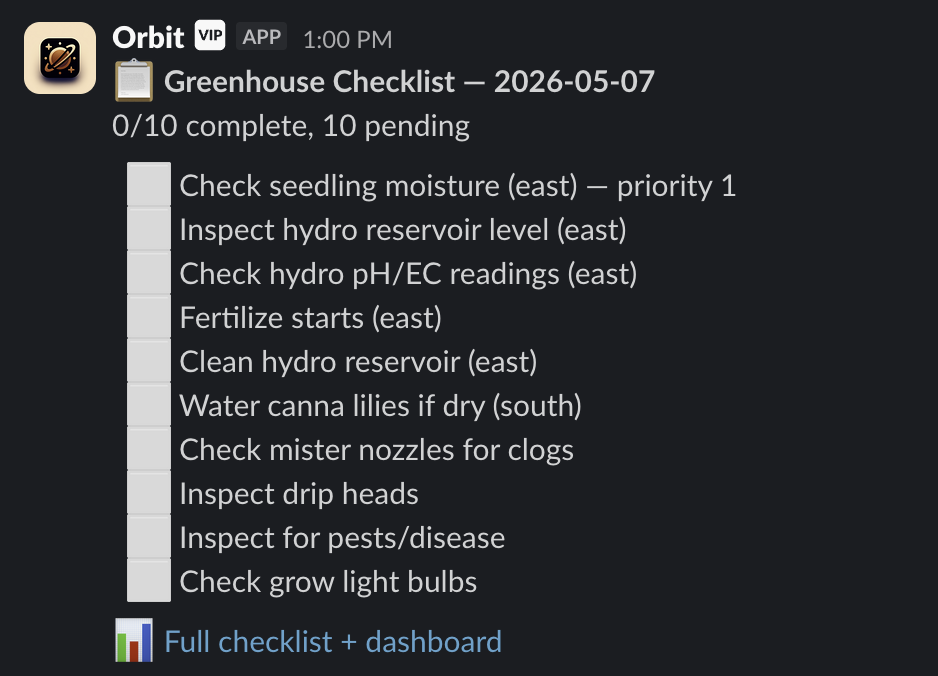
Posts the daily greenhouse task queue: inspection, hydroponics, pest checks, grow-light checks, and maintenance reminders.
Slack is convenient for humans, but the source of truth remains plan_journal, alert_log, daily plan pages, telemetry, and scorecards.
Where Slack Fits
Slack is the operator narrative wrapped around the same planning loop that powers the public archive. The event still enters through OpenClaw. Iris still writes plans through MCP. The dispatcher and ESP32 still enforce the control boundary. Slack is where the system explains itself to the people doing the physical work.
Sunrise, sunset, forecast changes, deviations, or manual checks create a planning trigger.
The trigger is routed to Iris with context, memory, forecast, crop bands, lessons, and audit headers.
Iris writes bounded tactics through MCP: plan IDs, hypotheses, waypoints, and tunables.
The dispatcher pushes validated setpoints; the ESP32 owns relay decisions every 5 seconds.
Slack receives the human-readable summary: what changed, why, what to watch, and what a human should do.
The same cycle lands in the planning archive, scorecards, telemetry dashboards, and lessons.
A Successful Plan Lands In Plain English
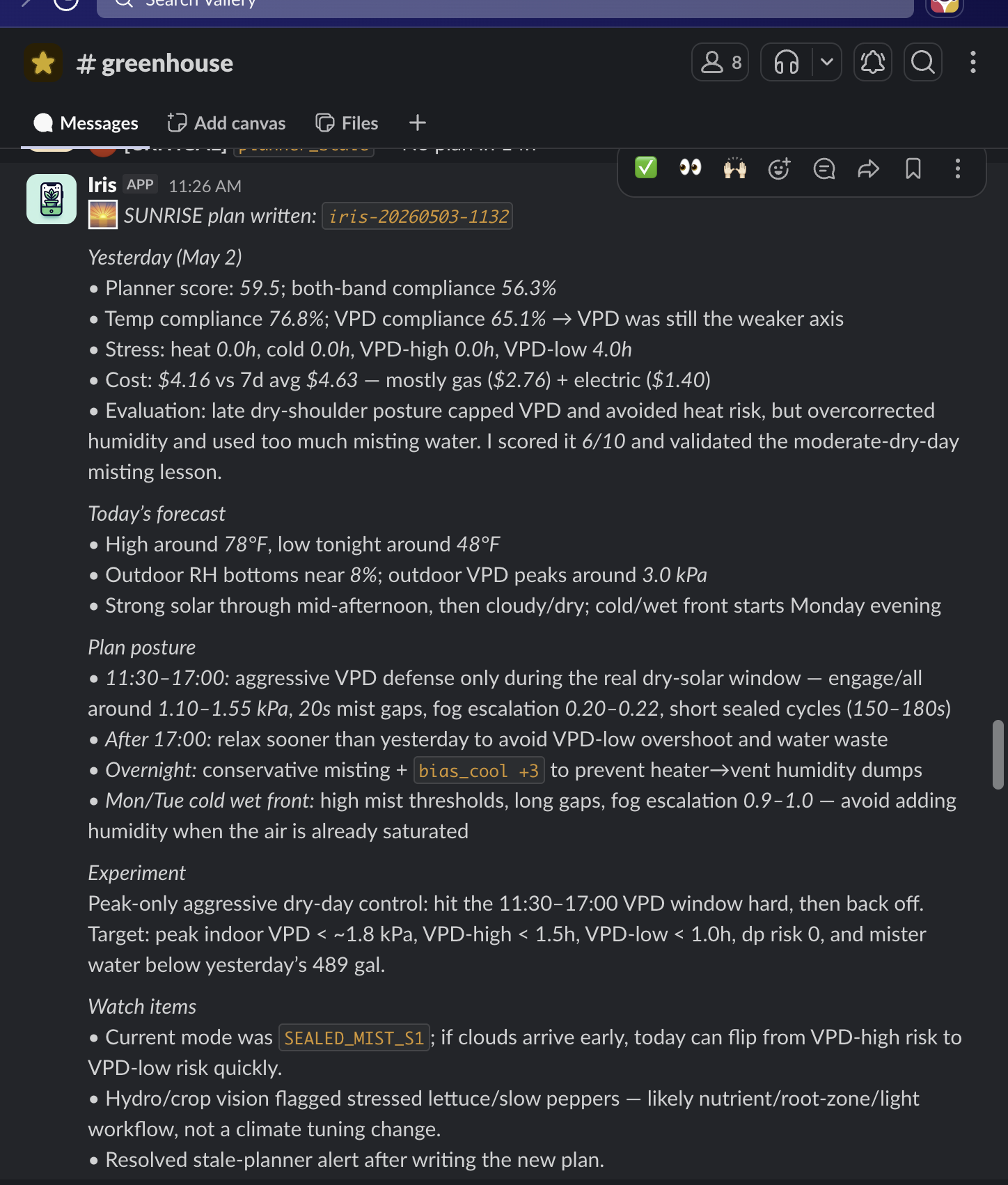
The lead example is a normal successful planning cycle. Iris writes the SUNRISE plan, names the plan ID, summarizes yesterday’s outcome, reads today’s forecast, states the plan posture, defines the experiment, and gives watch items for the operator.
This is the human-friendly wrapper around the planning loop. The public archive keeps the full record, but Slack makes the plan understandable at the moment it lands: what happened yesterday, what changed in the forecast, what Iris is trying today, and what could still go wrong.
The Work Queue Is Still Human
The greenhouse has a real maintenance surface: seedlings need moisture checks, hydroponic pH and EC need inspection, reservoirs need cleaning, misters clog, drip heads need inspection, pests show up, and grow lights fail.
Orbit posts this as a daily checklist rather than pretending the AI controls every physical task. That distinction matters. Verdify can notice patterns and remind the operator, but many greenhouse actions are still hands, eyes, and judgment.
Deviations Become Adjustments
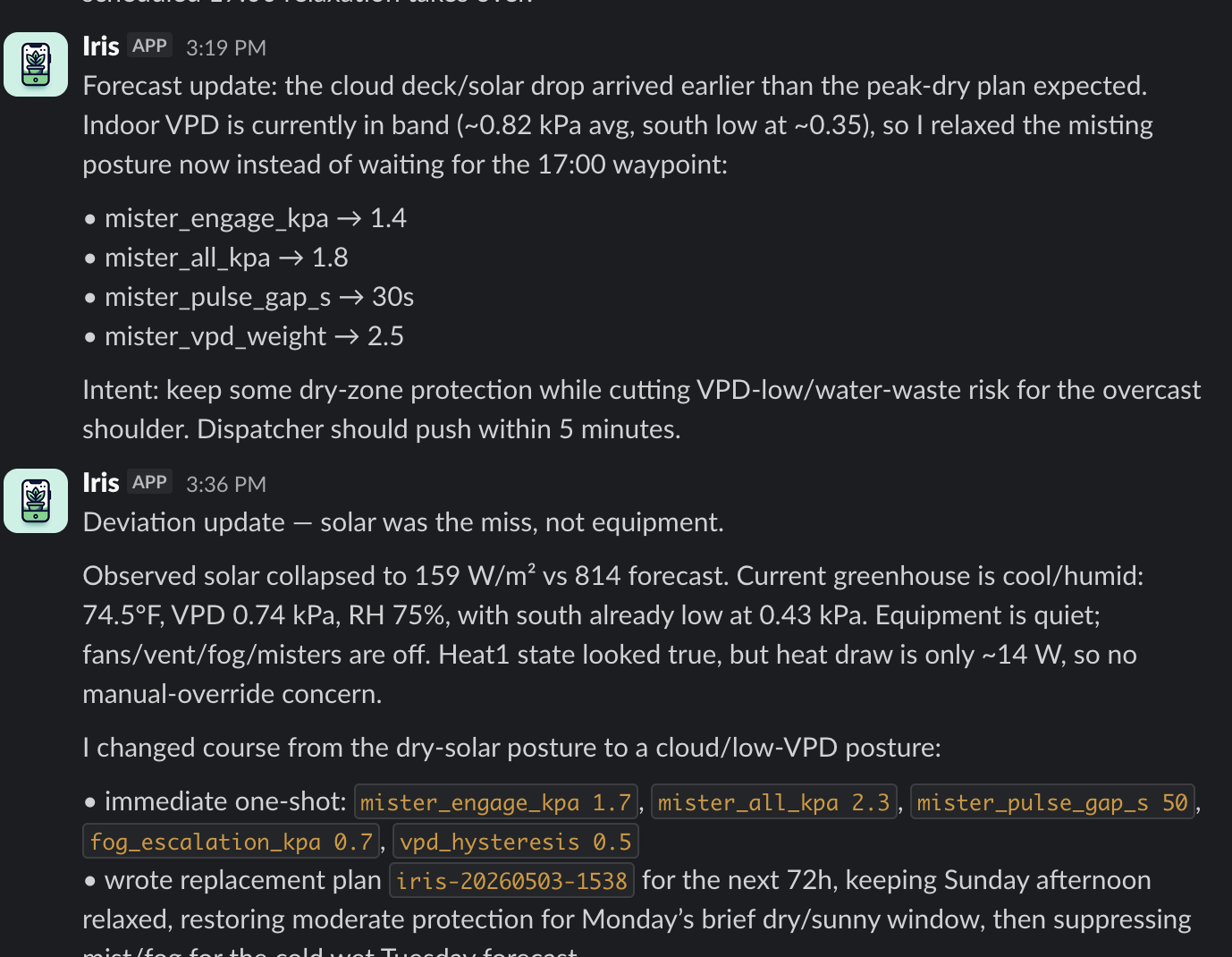
The third screenshot shows the part of the system that feels most like an operator assistant. The forecast expected a peak-dry solar window, but the cloud deck arrived early and solar collapsed. Iris explains that the miss was solar forecast error, not equipment failure. It then relaxes mister and fog posture, writes a replacement plan, and names the plan ID.
This is the Slack version of the planning loop: observed conditions diverge from the plan, Iris evaluates whether the current tactic still makes sense, then writes bounded setpoints or a replacement plan. The message includes enough detail for a human to challenge it: observed solar, VPD, RH, equipment state, changed tunables, and intent.
What Slack Is Allowed To Do
| Slack interaction | What happens | Safety boundary |
|---|---|---|
| Daily plan summary | Iris posts forecast, prior scorecard, intended posture, expected risks, and plan IDs. | The plan still lands through OpenClaw, MCP validation, dispatcher checks, and ESP32 enforcement. |
| Climate deviation | Iris explains the observed-vs-forecast miss and may write a replacement plan or immediate bounded tunables. | Slack does not flip relays; the ESP32 firmware decides physical state. |
| Task reminders | Orbit posts operator work like hydro checks, pest inspection, reservoir service, and grow-light checks. | A human performs the task and interprets physical conditions. |
| Exception visibility | Sensor issues, stale data, or critical/high alerts can show up in the same operator channel when something needs attention. | The canonical record stays in alert_log and public health endpoints. |
Slack messages are downstream of the event chain. A Slack post can explain a plan, remind a human, or link to evidence; it should not be read as proof that Slack itself approved or executed a physical action.
Why This Matters
The public site shows the receipts after the fact. Slack is where the system becomes operational in the moment. A good plan is not just “the model decided something.” It is a readable operator brief with the plan ID, evidence, intended tactics, experiment, and watch items.
That also keeps the story honest. Verdify is not an autonomous greenhouse that magically handles everything. It is a local-first AI planning system around a real greenhouse, with visible human operations, bounded automation, and public evidence for the plan, the tasks, and the adjustments.
Related pages: