Vanda Orchids
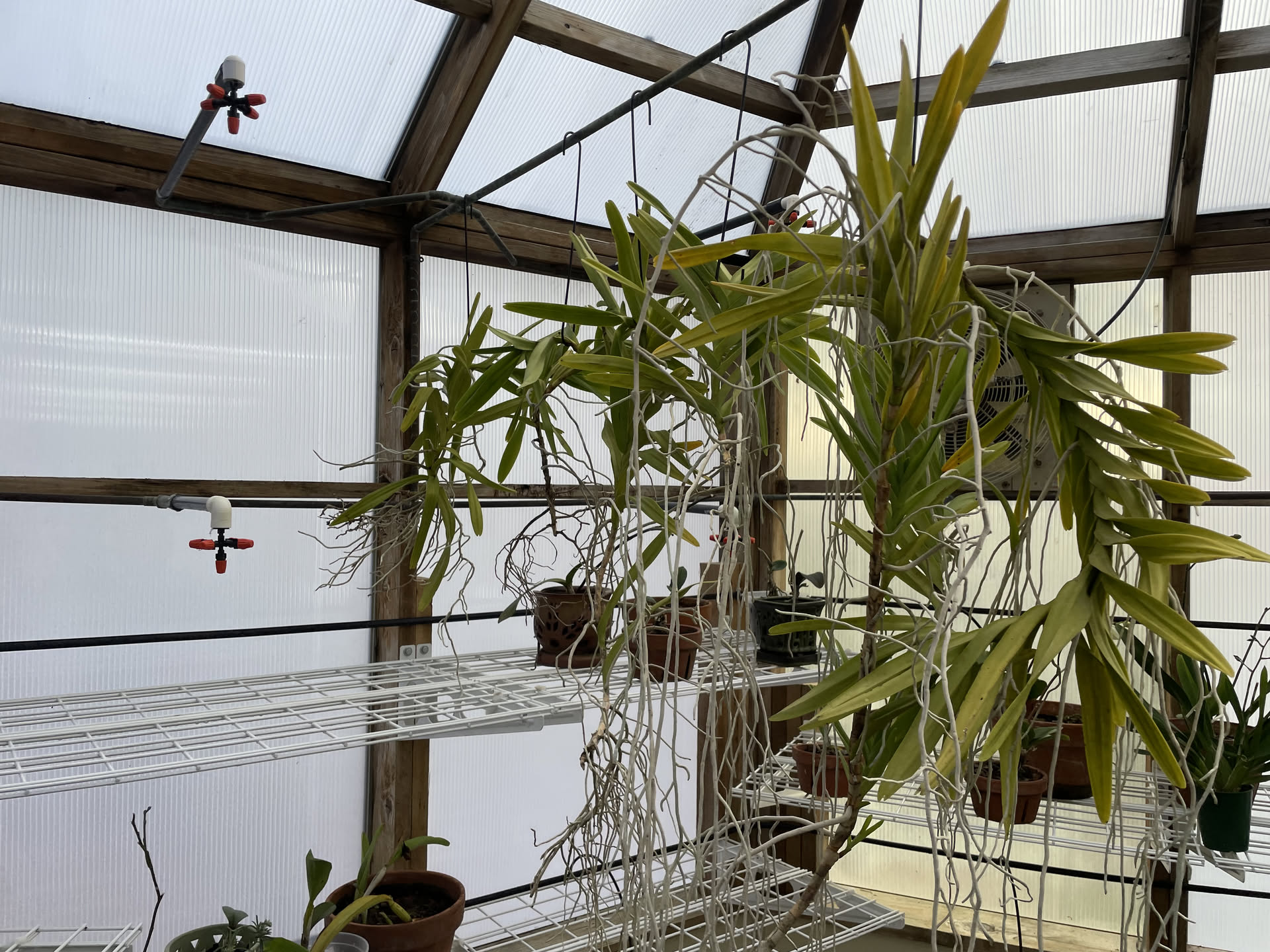
Tropical epiphytes from Southeast Asia. Vandas are documented here as an observed/reference crop for the center zone, but they do not count toward launch active control while the center zone is offline. They want warm temperatures, high humidity, and strong light. At 5,000 feet in Colorado, the dry air is their biggest enemy.
Optimal Conditions
| Parameter | Range | Notes |
|---|---|---|
| Day temperature | 75-85F | Tolerates higher than most greenhouse crops |
| Night temperature | 60-65F | Needs warm nights, 15F DIF is ideal |
| VPD | 0.4-0.8 kPa | Low to moderate. High VPD desiccates aerial roots |
| DLI | 10-15 mol/m2/d | Bright indirect. Direct sun can burn leaves |
| Humidity | 60-80% | Critical for aerial root health |
| Watering | Daily soak | Roots dry completely between waterings |
Catalog Entry
Slug orchid; category ornamental.
Cycle 365-540; scientific name —.
Default DLI; default VPD 0.50-0.90 kPa.
Launch Taxonomy
Does not count toward the active-control crop total. Observed Vanda reference only: center-zone page is OFFLINE and says no active planting.
Current occupied positions from v_position_current: CENTER-HANG-1.
Target Bands
64.2–75.8°F; 0.35–0.83 kPa; DLI 10.0. Hours covered: 24.
If promoted back into active control, Vandas would have a wide temperature range (60-82F) but the lowest VPD ceiling (~0.60 at night, ~1.20 at peak). For launch they remain observed/reference only because the center zone is offline.
Zone Recommendation
Primary: Center Zone, mounted
The center zone gets balanced light from all sides and benefits from the fog system and overhead misters. Hanging positions are planned for Vandas, but center plumbing/status needs reconciliation before orchids can drive software control. The center zone’s proximity to the fog nozzle is the reason it remains the preferred future orchid location.
Colorado-Specific Challenges
Longmont’s 15% afternoon relative humidity is the opposite of what Vandas evolved for. At these conditions, VPD can spike above 2.0 kPa, which desiccates the aerial roots and halts growth. The greenhouse’s misting and fog systems are critical for Vanda survival.
The future trade-off: misting to support orchids can introduce moisture that lettuce does not want. That remains a planning constraint, not a launch active-control input.
Care Notes
- Watering: Daily morning soak (submerge roots for 10-15 minutes). In summer, twice daily.
- Fertilizer: Weekly, weakly. 1/4 strength balanced orchid fertilizer.
- Light: Bright filtered. The opal polycarbonate is ideal. No direct midday sun on leaves.
- Root health: Green roots = hydrated. Silver-white = thirsty. Brown/mushy = overwatered or rotting.
- Blooming: Requires 15-20F DIF (day-night temperature differential) for 2-3 weeks to initiate spikes.
Where to Go Next
- Center Zone — planned/observed orchid location with overhead misters
- Humidity and VPD — how the greenhouse manages the VPD ceiling orchids need
- Growing at 5,000 Feet — altitude and arid air: the core challenge for tropical epiphytes
Current Plantings
CENTER-HANG-1vegetativePlanted 2026-04-02; 36 days in place.
This DB position record is retained as an observation/reference source, but center-zone status is OFFLINE, so Vanda orchids are excluded from the active-control crop count.
Latest Vision
 2026-05-08 06:00greenhouse_1 · south · health 6/10
Orchids hanging in the center appear somewhat limp, possibly due to low temperature or high humidity.
 2026-05-08 02:00greenhouse_1 · south · health 4/10
Orchids hanging in the center appear severely stressed, with significant browning and wilting of leaves and roots.
 2026-05-07 22:00greenhouse_1 · south · health 7/10
Hanging roots appear healthy, but hard to see foliage clearly.
Planting History
CENTER-HANG-12026-04-02 to —— days; final stage vegetative; events 1.