What the record shows
A governed learning loop can be inspected in operation.
AI proposals, control checks, firmware authority, telemetry, scorecards, lessons, and failures remain connected in a public operating record.
Greenhouse learning-loop proof
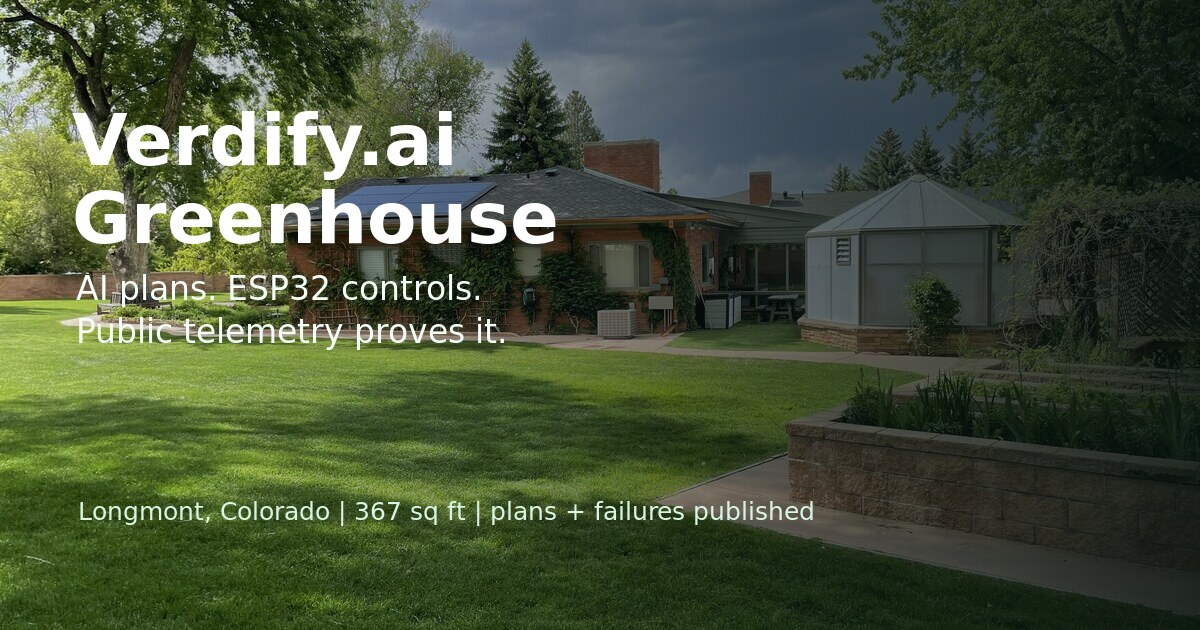
Verdify Lab is a live greenhouse where AI can reason over operating context and propose narrow tactics, but deterministic controls and firmware retain physical authority. Telemetry, resource use, failures, and outcomes decide what the loop learns next.
The transferable point: the greenhouse is not the client solution. It is a public pattern for keeping knowledge, authority, evidence, and learning connected inside one governed system.
Read the claim correctly
What the record shows
AI proposals, control checks, firmware authority, telemetry, scorecards, lessons, and failures remain connected in a public operating record.
What it does not show
The windows were not randomized or weather-normalized. This record does not prove full autonomy, yield optimization, profit optimization, or agronomic causality.
Why it matters
The useful outcome is not that AI is always right. It is that influence is constrained, checked, scored, corrected, and reviewed before scope expands.
Authority separation
The lab is useful because the roles are explicit. AI proposes. Controls constrain. People judge. Telemetry verifies. Outcomes become learning signal.
AI proposes. Controls constrain. People judge. Telemetry verifies. Outcomes become learning signal. Every stage has a named owner, a constrained interface, and evidence that can confirm—or contradict—the plan.
Reads operating context and proposes narrow climate tactics, hypotheses, or no-change intent through approved fields.
Checks parameters, ranges, required identifiers, ownership, freshness, and unsupported writes before intent moves forward.
Owns relay behavior, applies local safety rules, and controls physical equipment from trusted state. AI must not bypass it.
Records telemetry, delivery logs, readbacks, scorecards, summaries, and lessons so the result stays traceable.
Sets intent, reviews exceptions, and decides whether the system should tune, hold, stop, or earn more scope.
Full operating comparison
The public comparison shows a different operating record across climate, stress, water, modeled energy, modeled cost, and planner score. It is useful precisely because the tradeoffs remain visible.
Fixed windows
Public
Dated
Versioned
| Metric | Planner offline | AI planning online |
|---|---|---|
| Average AI plans/day | 0.0 | 3.0 |
| Both-axis compliance | 20.6% | 54.7% |
| Temperature compliance | 44.9% | 70.9% |
| VPD compliance | 30.3% | 74.5% |
| Graded compliance | 63.4% | 67.3% |
| Combined temperature + VPD stress (axis-hours/day; 48 possible) | 29.9h | 13.1h |
| Water/day | 429.6 gal | 240.1 gal |
| Runtime-modeled electric energy/day | 19.1 kWh | 29.1 kWh |
| Modeled operating cost/day (source currency) | 7.89 | 8.31 |
| Planner score | 25.9 | 52.7 |
Comparison window: Planner offline: April 22-25, 2026. AI planning online: April 26-May 2, 2026.
Claim limit: Dated operational comparison with weather, solar, equipment, crop, and instrumentation confounders; not a controlled A/B test or isolated causal proof.
Snapshot: July 10, 2026. Registry: 2026-07-10.commercial-greenhouse-proof.v3.
Inspect the source comparisonWhat transfers
A greenhouse is physical, but the architecture is familiar: narrow tools, deterministic gates, readbacks, private evals, an exception lane, and feedback that stays with the organization.
AI prepares source-linked evidence; security and legal owners approve outbound claims; reviewer edits improve the answer base.
AI assembles traceability; required owners sign off; missing links become visible knowledge work rather than hidden uncertainty.
AI prepares deviation evidence and routes the case; authorized reviewers decide; the decision improves future preparation.
Known limits
Inspect the record
This page is a dated commercial interpretation. The Live Lab is the technical source of truth for current plans, scorecards, lessons, failures, and known limits.
Operations, planning quality, resource use, archives, and public-safe exports.
Why the planning system cannot control relays or bypass firmware authority.
How context, tool calls, dispatch, scorecards, and lessons fit together.
The fixed-window operational comparison with caveats.
Weather, sensor, equipment, and physical-world constraints behind the numbers.
Validated lessons that constrain how the planner should operate next.
From proof to your workflow
Start with what AI may do, what it must not do, who retains authority, which feedback should be captured, and what evidence would justify expansion.